Advance UV Visible Spectrophotometer offered are latest technology based systems and feature photometric accuracy of 0.1 %T, photometric repeatability of +0.3 %T, photometric display range of -0.3-3.0A,0-200%T, 0-9999C and stability of +0.002A/h @ 500nm. Further, the system also comes with stray light support of 0.3%T @220nm, 360nm, USB based data output port, parallel printer support, display support in form of 128*64 Dots LCD and Deuterium & Tungsten Halogen Lamps. Some of the other standard features include automatic wave length setting, silicon photodiode based detector support and power requirements of AC220V/50 Hz.
Technical Specifications:
Optical System
| Single Beam, Grating 1200 lines/mm |
Wavelength Range | 200-1000nm |
Band Width | 1 nm |
Wavelength Accuracy | 0.5 nm |
Wavelength Repeatability | +0.1nm |
Wavelength Setting | Automatic |
Photometric Accuracy | 0.1 %T |
Photometric Repeatability | +0.3 %T |
Photometric Display Range | -0.3-3.0A,0-200%T, 0-9999C |
Stability | +0.002A/h @ 500nm |
Stray Light | 0.3%T @220nm, 360nm |
Data Output Port | USB |
Printer Port | Parallel Port |
Display | 128*64 Dots LCD |
Lamps | Deuterium Lamp & Tungsten Halogen Lamp |
Detector | Silicon Photodiode |
Power Requirement | AC220V/50 Hz |
The Advance UV Visible Spectrophotometer offers exceptional wavelength accuracy of 0.5 nm and a broad measurement range spanning 190 nm to 1100 nm. This permits highly precise detection of absorbance in diverse samples, supporting trusted results for both qualitative and quantitative analysis across academic, pharmaceutical, and industrial sectors.
Equipped with USB and RS232 interfaces and a digital LCD display, this spectrophotometer simplifies data storage and transfer. Its 4-position manual cell holder accommodates sample volumes from 2 ml to 10 ml, enhancing flexibility for multiple testing protocols. The instruments auto zero adjustment streamlines calibration, ensuring consistent baseline flatness and reliable operation.
FAQs of Advance UV Visible Spectrophotometer:
Q: How does the Advance UV Visible Spectrophotometer ensure precise wavelength settings during analysis?
A: The device supports wavelength accuracy of 0.5 nm, allowing for exact wavelength selection using its semi-automatic controls. Users can set wavelengths within the 190 nm to 1100 nm range, with auto zero adjustment assisting in precise calibration before measurements.
Q: What types of samples and laboratory analyses are suitable for this spectrophotometer?
A: This spectrophotometer is designed for both quantitative and qualitative measurements of liquid samples ranging from 2 ml to 10 ml. It is effective in laboratory analysis for research, pharmaceutical testing, and industrial quality control, accommodating a broad spectrum of compounds absorbing in the UV and visible regions.
Q: When is it appropriate to use the selectable scan speed feature?
A: Selectable scan speeds (Fast/Medium/Slow) allow users to optimize analysis depending on the urgency and nature of the sample. Rapid scans are suitable for routine measurements, while slower speeds provide more detailed spectral data for intricate analyses.
Q: Where can data from the spectrophotometer be exported and stored?
A: Data can be exported via USB or RS232 interface, enabling integration with laboratory computers and specialized data management systems. This facilitates easy storage, analysis, and sharing of results for reporting or further research.
Q: What process should be followed to achieve accurate baseline stability and repeatability?
A: Prior to sample measurement, baseline flatness (0.002A from 200 to 1000 nm) should be validated by running a blank. The auto zero adjustment helps maintain this stability, while photometric repeatability of 0.15% T ensures consistent results across multiple measurements.
Q: How does this spectrophotometer benefit laboratory workflows and analysis reliability?
A: Offering features such as highly accurate readings, user-friendly digital display, and robust construction, the Advance UV Visible Spectrophotometer streamlines analysis processes, reduces manual errors, and enables reproducible, trustworthy outcomes for researchers and quality specialists.

 Send Inquiry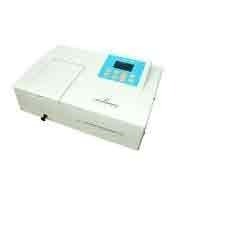

 Send Inquiry


 Send Inquiry





 Send Inquiry
