
Call us now :07971671031
 Send Inquiry
 Send Inquiry
Bar Pendulum(Compound Pendulum)
Bar Pendulum(Compound Pendulum) Specification
- Accuracy
- High precision for laboratory measurements
- Measurement Range
- Dependent on experimental setup (typical: period of oscillation, length of bar)
- Core Components
- Steel Bar with holes, Knife edges, Support Stand
- Automation Grade
- Manual
- Temperature Range
- Ambient
- Power Source
- Manual
- Equipment Materials
- Mild Steel (Bar); Metal Stand
- Type
- Compound Pendulum (Bar Pendulum)
- Dimension (L*W*H)
- Bar Length: 100 cm approx.; Width: 2.5 cm; Thickness: 0.8 cm
- Weight
- Approx. 1 to 1.5 kg (Bar only)
- Knife Edge Material
- Hardened steel
- End Type
- Machined flat ends
- Recommended Use
- Undergraduate and postgraduate laboratory experiments
- Hole Spacing
- About 5 cm (center to center)
- Bar Material
- Mild steel, corrosion resistant
- Calibration
- Factory calibrated, laboratory ready
- Included Accessories
- Support stand and knife edges
About Bar Pendulum(Compound Pendulum)
A chrome plated steel bar of dimension 100x3.75x0.6cm. with a number of equidistant holes at equal intervals of 5cm. Provided with two removable knife edges passing through any one of the holes and with wall bracket.
Durable & Precise Construction
Engineered from corrosion-resistant mild steel, this bar pendulum features a robust build, ensuring long-term use and consistent performance in laboratory environments. The hardened steel knife edges and precisely machined holes facilitate high-accuracy experiments while withstanding repeated handling.
Laboratory Ready and Easy to Use
Delivered factory calibrated and supplied with a sturdy metal stand and accessories, this compound pendulum is ready for immediate integration into undergraduate and postgraduate physics curricula. Manual setup allows users to tailor experiments according to their research needs.
Versatile Experimental Applications
Featuring a 100 cm bar with 5 cm hole spacing, this compound pendulum supports a wide range of oscillatory experiments. It allows for investigation into topics such as the period of oscillation, center of mass, and gravitational acceleration, making it essential for both teaching and research.
FAQs of Bar Pendulum(Compound Pendulum):
Q: How is the compound pendulum set up for laboratory experiments?
A: To set up the compound pendulum, secure the mild steel bar onto the provided support stand using the hardened steel knife edges. Select your desired pivot points using the holes spaced every 5 cm and ensure the bar is balanced before beginning your measurements.Q: What materials are used in the construction of the bar and knife edges?
A: The bar is manufactured from corrosion-resistant mild steel, while the knife edges are crafted from hardened steel to provide durability, reduce wear, and ensure precise oscillation during experiments.Q: When is the pendulum ready for use after delivery?
A: The pendulum arrives factory calibrated and laboratory ready, meaning you can use it immediately upon delivery with minimal setup, ideal for efficient laboratory workflows.Q: Where can this compound pendulum be used?
A: It is suitable for undergraduate and postgraduate laboratories in educational and research institutions. Its portability and ease of use also make it ideal for experimental demonstrations and science education outreach.Q: What is the process for measuring the period of oscillation?
A: Attach the bar to the stand at your chosen hole spacing, displace the bar gently, and allow it to oscillate. Use a stopwatch to measure the time for several complete oscillations, then calculate the period by dividing the total time by the number of oscillations.Q: How does using this pendulum benefit laboratory experiments?
A: Its high-precision construction and ease of manual operation enable students and researchers to accurately study complex pendulum concepts, supporting in-depth investigations into physics topics like center of gravity and moment of inertia.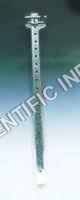
Tell us about your requirement

Price:
Quantity
Select Unit
- 50
- 100
- 200
- 250
- 500
- 1000+
Additional detail
Mobile number
Email

More Products in Physics instruments Category
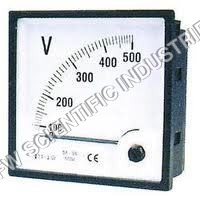
Ammeter
Accuracy : Class 1.5
Equipment Materials : ABS Plastic, Glass Front
Core Components : Coil, Magnet, Scale, Pointer
Automation Grade : Manual
Feature : Shock Resistant, Clear Markings
Power Source : Electrical (SelfPowered via Measurement Circuit)
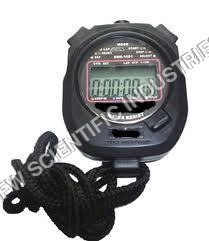
Digital Stop watch
Accuracy : 0.01 seconds
Equipment Materials : ABS Plastic
Core Components : Electronic Quartz Movement, LCD Display
Automation Grade : Manual
Feature : Split/Lap Time, Alarm, Calendar, Time, Waterproof
Power Source : Button Cell Battery (1 x LR44/AG13)
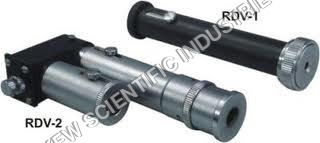
Direct Vision Spectroscope
Accuracy : Spectral lines observed with high clarity
Equipment Materials : Metal body with glass prisms and lenses
Core Components : Prisms, Lenses, Eyepiece, External body casing
Automation Grade : Manual
Feature : Portable, lightweight, handheld, easy to use
Power Source : Not required, manual operation
Electromagnetism Coil
Accuracy : 2%
Equipment Materials : Copper wire, Ferrite core, Insulation
Core Components : Copper Coil, Iron/Ferrite Core
Automation Grade : Manual
Feature : High magnetic field generation, robust insulation, compact size
Power Source : Electric (AC/DC) Source

 Send Inquiry


Our Products
- Slit Lamp Ophthalmic Equipment
- Slit Lamp
- Surgical Equipments
- Laboratories Instruments Equipment
- Microscopes
- Scientific Instruments
- ENT Equipment
- Pharmacy instrument equipment
- Pathological Equipment
- Physics Lab Equipments
- Physics instruments
- Laboratory Glassware
- Digital Polarimeter
- Microprocessor Viscometer
- Double Beam UV-VIS Spectrophotometer
- Single Beam UV-Vis Spectrophotometer
- Kitchen equipments
- Dental Equipment
- Chapati Making Machines
- Water Heating System OR Hamam
- High Performance Liquid Chromatography Systems
- Chemistry
- Equipment Accessories
- Gynecology Equipment


B.O : 5430/3, Anaj Mandi, Science Market, Near Nigar Cinema,
R.O : 102-B Ram Nagar,Ambala Cantt - 133001, Haryana, India

Mr VISHAL KUMAR
(Managing Director)
Mobile :07971671031
 Send Inquiry
Developed and Managed by Infocom Network Private Limited.
