
Call us now :07971671031
 Send Inquiry
 Send Inquiry
Abbe Refractometer
Abbe Refractometer Specification
- Max Height
- Approx. 250 mm
- Operating Voltage
- 220V AC
- Response Time
- Instantaneous
- Number of Specimens
- Single sample measurement
- Power Supply
- 220V, 50Hz AC
- Display Type
- Analog scale with vernier reading
- Resolution
- 0.0005 (Refractive Index)
- Automation Grade
- Manual
- Humidity
- 85% RH
- Measuring Range
- Refractive Index: 1.3000 to 1.7000; Brix: 0% to 95%
- Application
- Measurement of refractive index and dispersion of liquids and solids
- Mounting Type
- Bench-top
- Temperature
- 10C to 30C
- Equipment Type
- Abbe Refractometer
- Accuracy
- 0.0002 (Refractive Index)
- Features
- Compact design, high accuracy, temperature correction, prism made of high quality glass
- Test Range
- 1.300 to 1.700 Refractive Index
- Specimen Size
- Few drops (Liquid) or thin film (Solid)
- Frequency
- 50 Hz
- Usage
- Scientific laboratories, quality control
- Machine Weight
- 2.5 kg
- Test Speed
- Manual operation
- Control Mode
- Manual
- Temperature Control
- Built-in analog thermometer (0C to 70C) for prism temperature monitoring
- Operating Conditions
- Indoor use only, avoid direct sunlight exposure
- Light Source
- Daylight or built-in illumination (lamp attachment)
- Color Scale
- Dispersion values: nF-nC (e.g., 0.008 to 0.040)
- Calibration
- Via reference standards
- Thermometer Precision
- 0.5C graduation
- Dimensions
- 200 mm x 100 mm x 250 mm
- Sample Type
- Transparent, translucent or slightly opaque liquids/solids
- Prism Material
- Optical glass
About Abbe Refractometer
Abbe Refractometer
Abbe refrectometer For accurate measurement of index of refraction of transparent liquids, solids and solutions.For use in Sugar, Ghee and Oil Mills Pharmaceuticals and Chemical Laboratories, JAM Factories and Distillaries etc. Measuring range 1.3000 to 1.7000. Measurement of Sugar 0% to 95% Complete | ||||||
Designed for the Accurate & quick Examination of the Refractive Indices & Mean Dispersion of Liquids. Solids & Oil. | ||||||
ND Range : N.D. 1.3000 to N.D. 1. 7000 in steps of 0.001
|
High-Precision Measurements
Experience pinpoint accuracy with refractive index measurements ranging from 1.3000 to 1.7000 and Brix scale readings from 0% to 95%. The Abbe Refractometer's analog vernier delivers detailed results, while its consistent temperature control ensures repeatable performance across a variety of liquid and solid samples.
User-Friendly and Versatile
Designed for manual operation, the compact Abbe Refractometer accommodates both liquid drops and thin solid films. Its intuitive controls and immediate response time make it suitable for laboratory professionals in quality control, research, and education, where reliable and swift measurements are critical.
Built-In Temperature Monitoring
With an integrated analog thermometer ranging from 0C to 70C and a precision of 0.5C, this refractometer allows accurate monitoring and necessary correction for temperature-sensitive measurements, ensuring exceptional consistency in your data.
FAQ's of Abbe Refractometer:
Q: How does the Abbe Refractometer ensure accurate measurement of refractive index?
A: The refractometer achieves high accuracy (0.0002) through a precision optical glass prism, analog vernier reading, and built-in temperature monitoring, which corrects for temperature variations between 0C and 70C, providing reliable results for both liquids and solids.Q: What types of samples can be measured with this refractometer?
A: You can measure transparent, translucent, or slightly opaque liquids and solids. For liquids, only a few drops are needed, while for solids, a thin film is sufficient to obtain accurate readings.Q: When should temperature corrections be applied during measurement?
A: Temperature corrections are important whenever sample temperature deviates from standard reference conditions. The built-in thermometer enables you to monitor the prism temperature and apply necessary corrections, especially for temperature-sensitive substances.Q: Where is the optimal environment to operate the Abbe Refractometer?
A: Operate the instrument indoors, away from direct sunlight, within a temperature range of 10C to 30C, and relative humidity up to 85%. This ensures both user safety and the accuracy of your measurements.Q: What is the process for calibrating the refractometer?
A: Calibration is performed using reference standards with known refractive indices. These standards are used to set the baseline on the instrument's analog scale, ensuring accuracy before measuring unknown samples.Q: How can users benefit from the built-in analog thermometer?
A: The thermometer, with a 0.5C graduation range from 0C to 70C, monitors prism temperature closely, allowing users to make temperature corrections. This helps to maintain accuracy for samples sensitive to thermal changes.Q: What is the key benefit of the compact bench-top design?
A: The compact and lightweight design (2.5 kg, 200100250 mm) allows for easy handling and stable installation in limited laboratory spaces, making the refractometer both portable and convenient for routine quality control tasks.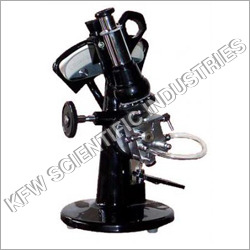
Tell us about your requirement

Price:
Quantity
Select Unit
- 50
- 100
- 200
- 250
- 500
- 1000+
Additional detail
Mobile number
Email

More Products in Testing & Measuring Equipment Category
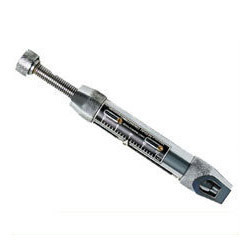
Monsanto Type Tablet Hardness Tester
Automation Grade : Manual
Usage : Laboratory testing of tablet hardness
Application : Used to test the hardness of tablets in pharmaceutical laboratories
Control Mode : Manual
Features : Portable, easy to operate, durable body, precise analog reading
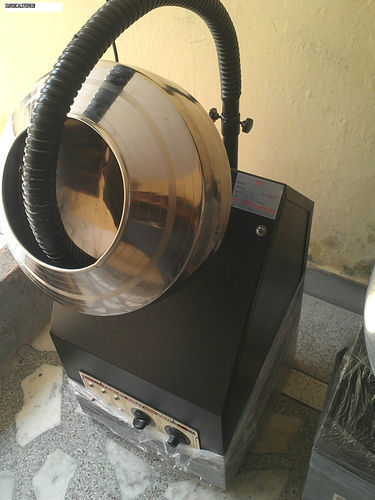
Tablet Coating Pan
Automation Grade : SemiAutomatic/Automatic
Usage : Pharmaceutical, Laboratory, Industrial
Application : Film and sugar coating of tablets, confectionery, capsules
Max Height : Up to 1200 mm (depending on model)
Control Mode : Manual/Automatic
Features : Stainless steel pan, Gear Box drive, Hot air blower, Variable speed
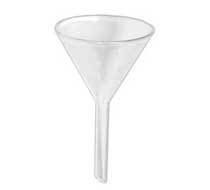
FUNNEL KFW
Automation Grade : Manual
Usage : Paper and pulp testing laboratories
Application : Pulp and paper sheet freeness testing; Laboratory analysis
Max Height : Approx. 300 mm
Control Mode : Gravity/manual
Features : Corrosionresistant; easy to clean; standardcompliant design
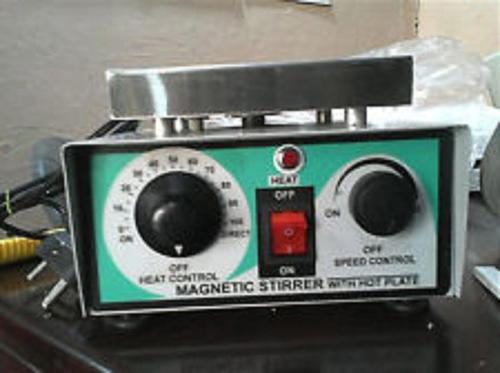
Magnetic Stirrer With Hot plate Laboratory Magneti
Automation Grade : Manual
Usage : Mixing and heating laboratory samples
Application : Laboratory mixing and heating
Max Height : 140 mm
Control Mode : Analog Control
Features : Magnetic stirring; Uniform heating; Speed control; Chemicalresistant body

 Send Inquiry


Our Products
- Slit Lamp Ophthalmic Equipment
- Slit Lamp
- Surgical Equipments
- Laboratories Instruments Equipment
- Microscopes
- Scientific Instruments
- ENT Equipment
- Pharmacy instrument equipment
- Pathological Equipment
- Physics Lab Equipments
- Physics instruments
- Laboratory Glassware
- Digital Polarimeter
- Microprocessor Viscometer
- Double Beam UV-VIS Spectrophotometer
- Single Beam UV-Vis Spectrophotometer
- Kitchen equipments
- Dental Equipment
- Chapati Making Machines
- Water Heating System OR Hamam
- High Performance Liquid Chromatography Systems
- Chemistry
- Equipment Accessories
- Gynecology Equipment


B.O : 5430/3, Anaj Mandi, Science Market, Near Nigar Cinema,
R.O : 102-B Ram Nagar,Ambala Cantt - 133001, Haryana, India

Mr VISHAL KUMAR
(Managing Director)
Mobile :07971671031
 Send Inquiry
Developed and Managed by Infocom Network Private Limited.
