
Call us now :07971671031
 Send Inquiry
 Send Inquiry
Heating Mental
Heating Mental Specification
- Number of Specimens
- 1
- Resolution
- 1C
- Equipment Type
- Laboratory Heating Mantle
- Mounting Type
- Bench Top
- Test Range
- Up to 400C
- Display Type
- Analog
- Power Supply
- 230 V AC, 50 Hz
- Features
- Uniform heating, chemical resistance, energy efficient, overheat protection
- Automation Grade
- Manual
- Application
- Laboratory heating, chemical analysis, pharmaceutical research
- Usage
- Laboratory heating of liquids
- Control Mode
- Manual
- Cord Length
- 1.5 meters
- Insulation
- Glass wool insulation for minimum heat loss
- Safety Feature
- Fuse protection and earthing
- Working Principle
- Surface contact heating to round bottom flasks
- Inner Material
- Fiber glass net
- Control Type
- Energy regulator
- Heating Element Type
- Nichrome wire
- Color
- White or blue (subject to availability)
- Outer Material
- Powder coated mild steel
About Heating Mental
Heating MentalKFW SCIENTIFIC INDUSTRIES
Brand Name - KFW
HEATING MENTAL Lab ScienceHeating&Cooling Heating Mantles 50ml Heating Mantles - KFW
Suitable for laboratories, chemicals, pharmaceuticals, Dyes, Glass plants etc. Particularly useful for Heating inflammable liquids. Electric heating net is hand knitted from glass Yarn and there is no joint to maintain the strength of the yarn and stands high temperature up to 350 degree c. the body of the mantle is spun one piece from non-rusting Aluminum (up to 5.0 liters Capacity) duly stoving painted. All heating mantles are lagged with special grade mineral wool.
To work on 110/220/230 Volts AC.
NOTE:-
ITS IS THE COST OF 50 ml WITH 60 watt AND PRICE ARE CHANGE AS PER CAPACITY AND WE ARE AVAILABLE ALL SIZES IN STOCK WITH BEST QUALITY..
Heating Mantles (Made of Glass yarn): With ON/OFF Switch
- Size: 50 ml
- Watt/Circuits L60
Note: Multi heating Mantles can be also be made on requirement.
Uniform Heating for Laboratory ApplicationsAchieve consistent and controlled heating of liquids in round bottom flasks with the Heating Mantles nichrome wire element and premium fiber glass net lining. The design allows precise temperature regulation, ensuring reproducible results in laboratory tests, chemical analysis, and pharmaceutical research up to 400C.
Safety and Durability at the Forefront
This heating mantle prioritizes user safety with features such as fuse protection, proper earthing, and an insulated construction to reduce external heat loss. Its powder-coated exterior ensures durability, while the glass wool insulation enhances the devices overall efficiency and chemical resistance.
Manual Precision and Versatile Usage
Operate this bench-top equipment manually for direct, hands-on control over heating processes. The analog display and energy regulator facilitate accurate temperature settings, while the mantle accommodates flask sizes of 100 ml up to 2 liters, making it flexible for a wide range of laboratory heating applications.
FAQs of Heating Mental:
Q: How do I operate the heating mantle safely in my laboratory?
A: To operate the heating mantle safely, ensure it is properly earthed and connected to a 230 V AC, 50 Hz supply. Always use the fuse protection and avoid exceeding the maximum capacity of 2 liters. Place the round bottom flask centrally in the mantle, set the desired temperature using the manual energy regulator, and monitor the sample closely.Q: What types of flasks and liquids is this heating mantle suitable for?
A: This heating mantle is designed for round bottom flasks ranging from 100 ml to 2 liters. It uniformly heats most laboratory liquids, commonly used in chemical analysis and pharmaceutical research, thanks to its chemical-resistant materials and uniform surface heating principle.Q: When should I utilize the overheat protection features?
A: Overheat protection is automatically engaged to prevent the mantle from exceeding safe operating temperature. If you notice the fuse has blown or the device shuts off unexpectedly, allow the mantle to cool, check connections, and replace the fuse if necessary before resuming operation.Q: Where can I install and use this heating mantle?
A: Install the mantle on a stable laboratory benchtop near a dedicated 230 V AC power outlet. Ensure there is adequate ventilation and that the device is away from flammable materials, making it safe and effective for use in laboratories across academic, research, and industrial settings.Q: What is the process for setting and controlling the temperature?
A: Set the desired temperature using the manual energy regulator and refer to the analog display for monitoring. The mantle allows precise control, instant response, and consistent heat distribution up to 400C with a 1C accuracy, suitable for sensitive laboratory reactions.Q: How can I benefit from using this heating mantle in research?
A: Using this mantle provides uniform heat distribution, chemical resistance, and energy-efficient operation. Instant temperature response and overheat protection enhance laboratory safety and experiment reliability, making it ideal for research requiring consistent heating of chemicals or solutions.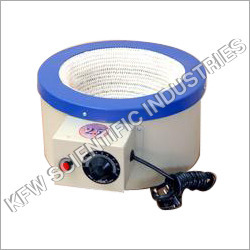
Tell us about your requirement

Price:
Quantity
Select Unit
- 50
- 100
- 200
- 250
- 500
- 1000+
Additional detail
Mobile number
Email

More Products in Laboratory Glassware Category
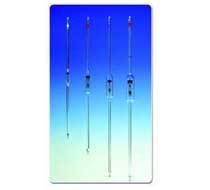
Pipettes
Usage : Laboratory liquid handling
Application : Used for liquid transfer, measurement, analytical, and biological laboratory applications
Mounting Type : Handheld
Automation Grade : Manual or Semiautomatic
Features : Autoclavable, UVResistant, Ergonomic Design, Volume Lock (varies by model)
Max Height : 180 250 mm (depends on pipette type)
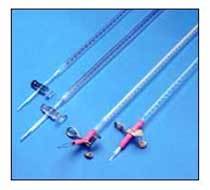
Volumetric Burette
Usage : Quantitative Chemical Analysis
Application : Laboratory Liquid Measurement, Titration
Mounting Type : Clamp Stand Mountable
Automation Grade : Manual
Features : Clear Calibrations, PTFE Stopcock, Durable Glass Construction, Chemical Resistant
Max Height : Approx. 50 cm
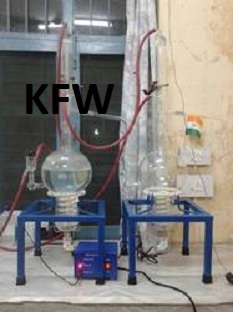
Water Distillation Apprutus
Usage : Distillation of Water
Application : Laboratory, Medical, Pharmacy, Research
Mounting Type : Table Top
Automation Grade : SemiAutomatic
Features : Quartz Heater, Pyrogen Free Distillate, Rust Proof Construction, Energy Efficient
Max Height : 600 mm
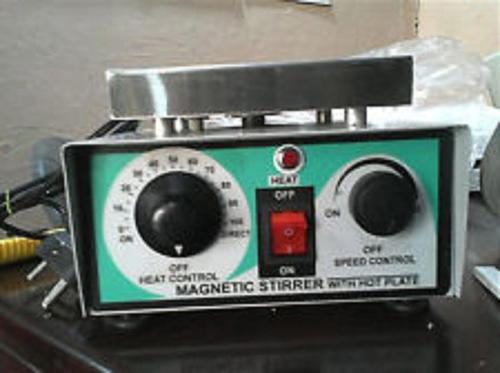
Magnetic Stirrer With Hot plate Laboratory Magneti
Usage : Mixing and heating laboratory samples
Application : Laboratory mixing and heating
Mounting Type : Table Top
Automation Grade : Manual
Features : Magnetic stirring; Uniform heating; Speed control; Chemicalresistant body
Max Height : 140 mm

 Send Inquiry


Our Products
- Slit Lamp Ophthalmic Equipment
- Slit Lamp
- Surgical Equipments
- Laboratories Instruments Equipment
- Microscopes
- Scientific Instruments
- ENT Equipment
- Pharmacy instrument equipment
- Pathological Equipment
- Physics Lab Equipments
- Physics instruments
- Laboratory Glassware
- Digital Polarimeter
- Microprocessor Viscometer
- Double Beam UV-VIS Spectrophotometer
- Single Beam UV-Vis Spectrophotometer
- Kitchen equipments
- Dental Equipment
- Chapati Making Machines
- Water Heating System OR Hamam
- High Performance Liquid Chromatography Systems
- Chemistry
- Equipment Accessories
- Gynecology Equipment


B.O : 5430/3, Anaj Mandi, Science Market, Near Nigar Cinema,
R.O : 102-B Ram Nagar,Ambala Cantt - 133001, Haryana, India

Mr VISHAL KUMAR
(Managing Director)
Mobile :07971671031
 Send Inquiry
Developed and Managed by Infocom Network Private Limited.
