
Call us now :07971671031
 Send Inquiry
 Send Inquiry
Laboratory Potentiometer
Laboratory Potentiometer Specification
- Voltage
- 210 V (working potential range)
- Capacity
- 1030 V (measuring potential difference up to 2V directly; higher voltage with resistance box)
- Frequency
- DC measurements only
- Measurement Range
- Up to 2V direct, higher with accessories
- Temperature Range
- Ambient laboratory temperature (typically 10C 50C)
- Automation Grade
- Manual
- Accuracy
- < 0.02 V (direct reading up to 2V, higher with resistance box)
- Equipment Materials
- Brass contacts, lacquered wooden base, resistance wire, cast iron supports, scale engraved on brass strip
- Usage
- Measurement of EMF, voltage calibration, comparison of cells
- Dimension (L*W*H)
- Approx. 420 mm 120 mm 150 mm
- Weight
- Approx. 2.53.5 kg
- Resistance Wire Material
- Manganin or Constantan
- Jockey
- Fitted metallic, insulated handle
- No. of Wire Slides
- One (precision slide contact)
- Calibration
- Provided with 1 Ohm standard resistor
- Operating Temperature
- 10C - 50C
- Scale Graduation
- Millimeter and centimeter markings
About Laboratory Potentiometer
We feel proud to introduce ourselves as a trustworthy entity, engaged in manufacturing, exporting and supplying a wide range of qualitative Laboratory Potentiometer. Manufactured using quality approved components and latest technology, this potentiometer is checked on stringent quality parameters to assure its reliability. Offered potentiometer finds its application in laboratories for determining voltage in a circuit. In addition, our valued clients can easily obtain this Laboratory Potentiometer in different specifications and at the nominal prices.
Features:
-
Sturdy design
-
Longer service life
-
No maintenance required
-
Accurate reading
Precision Voltage Measurements
With its high-accuracy resistance wire and fine scale graduation, this potentiometer is tailored for measuring EMF, calibrating voltmeters, and comparing cell voltages. Its practical design allows for straightforward, reliable measurements in laboratory environments.
Robust Construction and Calibration
Crafted with a lacquered wooden base, brass contacts, and a durable metallic jockey with an insulated handle, the potentiometer is built for daily laboratory use. The included 1 Ohm standard resistor guarantees initial calibration and confidence in results.
FAQs of Laboratory Potentiometer:
Q: How is the laboratory potentiometer used to measure EMF or calibrate voltages?
A: The potentiometer measures EMF or calibrates voltages by balancing an unknown voltage against a known reference, using a single precision slide contact and calibrated resistance wire. By adjusting the jockey along the millimeter scale, you obtain direct readings up to 2V and higher with a resistance box.Q: What is the operating temperature range and how does it impact performance?
A: The potentiometer is designed for ambient laboratory temperatures, typically between 10C and 50C. Within this range, the manganin or constantan wire maintains stable resistance, ensuring accurate and consistent voltage measurements.Q: When should a resistance box be used with this potentiometer?
A: A resistance box should be used when you need to measure voltages higher than 2V directly. By incorporating a resistance box, the measurement range expands while still maintaining accuracy below 0.02V.Q: Where can this potentiometer be effectively utilized?
A: This potentiometer is suitable for use in educational settings, calibration laboratories, research institutes, and quality control departments anywhere precise DC voltage measurement and calibration are required.Q: What are the main benefits of the manganin or constantan resistance wire in this instrument?
A: Both manganin and constantan offer low temperature coefficients, which means they provide stable resistance values even with temperature fluctuationscrucial for precise, repeatable voltage measurements in laboratory conditions.Q: How do the scale graduations improve measurement accuracy?
A: The finely marked millimeter and centimeter graduations on the brass scale allow users to identify exact positions along the resistance wire, helping achieve more precise readings and easier repeat measurements.Q: What is the process for routine calibration of this potentiometer?
A: Routine calibration is facilitated by the included 1 Ohm standard resistor. You connect the resistor and verify the potentiometers readings against known values, ensuring continued measurement accuracy over time.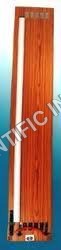
Tell us about your requirement

Price:
Quantity
Select Unit
- 50
- 100
- 200
- 250
- 500
- 1000+
Additional detail
Mobile number
Email

More Products in Physics instruments Category
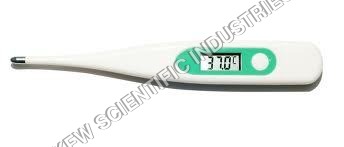
Clinical Digital Thermometer
Equipment Materials : Plastic Body with Stainless Steel Probe
Temperature Range : 32C 42C
Automation Grade : Manual
Accuracy : 0.1C
Usage : Body Temperature Measurement
Feature : Auto Power Off, Beeper Alert, Memory Recall
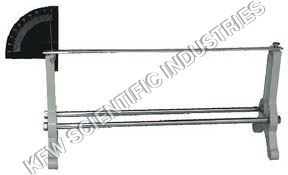
Expansion Apparatus
Equipment Materials : Baseboard, rods/tubes (usually copper, iron or aluminum), metal scale, fixed and sliding brackets
Temperature Range : Ambient to around 100C (boiling water)
Automation Grade : Manual
Accuracy : 0.01 mm scale division (typical)
Usage : Measurement of coefficient of linear expansion in rods/tubes
Feature : Manual operation, easy reading pointer system, fixed or replaceable rods/tubes
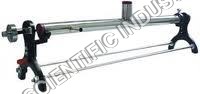
Linear Expansion Apparatus
Equipment Materials : Stainless steel tube, brass, aluminium
Temperature Range : Room temperature up to 100C
Automation Grade : Manual
Accuracy : 0.01 mm (using dial gauge)
Usage : Measurement of linear expansion of rods
Feature : Interchangeable rods, water jacket for uniform heating
Conductivity Apparatus
Equipment Materials : Stainless steel rods, insulating base, metal strips, test tubes, hardware components, plastic/wooden supports
Temperature Range : Ambient
Automation Grade : Manual
Accuracy : Demonstrativeintended for qualitative comparison not quantitative results
Usage : Demonstration of thermal conductivity of metals in physics laboratory
Feature : Multiple metal conductors for comparative study, easy for classroom demonstration, sturdy construct

 Send Inquiry


Our Products
- Slit Lamp Ophthalmic Equipment
- Slit Lamp
- Surgical Equipments
- Laboratories Instruments Equipment
- Microscopes
- Scientific Instruments
- ENT Equipment
- Pharmacy instrument equipment
- Pathological Equipment
- Physics Lab Equipments
- Physics instruments
- Laboratory Glassware
- Digital Polarimeter
- Microprocessor Viscometer
- Double Beam UV-VIS Spectrophotometer
- Single Beam UV-Vis Spectrophotometer
- Kitchen equipments
- Dental Equipment
- Chapati Making Machines
- Water Heating System OR Hamam
- High Performance Liquid Chromatography Systems
- Chemistry
- Equipment Accessories
- Gynecology Equipment


B.O : 5430/3, Anaj Mandi, Science Market, Near Nigar Cinema,
R.O : 102-B Ram Nagar,Ambala Cantt - 133001, Haryana, India

Mr VISHAL KUMAR
(Managing Director)
Mobile :07971671031
 Send Inquiry
Developed and Managed by Infocom Network Private Limited.
