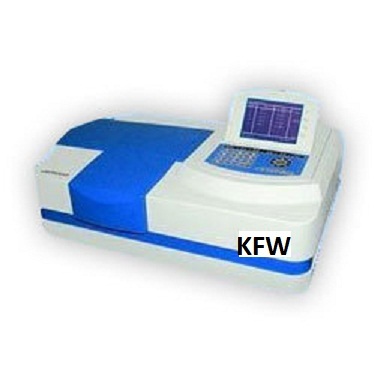
About Microprocessor UV / VIS Spectrophotometer (Double Beam)
Microprocessor UV / VIS Spectrophotometer (Double Beam) offered comes with wavelength range of 190-1100 nm Czerny Turner with spectral bandwidth of 1 nm and working mode in form of Basic/Quantative/Wavelength Scan/DNA Protein Test/Kinetics (T,A,C). The system also features double beam (1200 lines/mm Grating) based optical system, scanning speed options of Fast / Medium / Slow, photometric range of -0.3 - 3.5 A, 0 to 220 %T as well as wavelength accuracy of +0.3 nm. Some of the other standard features of the system include wavelength reproducibility of < 0.10 nm as well as available support in form of software CD, RS 232 Cable, operation manual among others.
Feature:-
Wavelength Range | 190-1100 nm Czerny Turner |
Spectral Bandwidth | 1 nm |
Working Mode | Basic/Quantative/Wavelength Scan/DNA Protein Test/Kinestics (T,A,C) |
Optical System | Double beam (1200 lines/mm Grating) |
Scanning Speed | Fast / Medium / Slow |
Photometric Range | -0.3 - 3.5 A, 0 to 220 %T |
Wavelength Accuracy | +0.3 nm |
Wavelength Reproducibility | < 0.10 nm |
Photometric Accuracy | + 0.3% T (0-100% T)
+0.002 A (0-0.1 A) |
Photometric Reproducibility | < 0.15 % T |
Stray Light | < 0.1% T (Nal. 220nm, NaNO2 340 nm) |
Software CD | 1 No. |
RS 232 Cable | 1 No. |
Operation Manual | 1 No. |
Detector | Dual Silicon Photodiode |
Display | 6 inches high light blue LCD |
Power | AC:220V + 10%, 50 Hz. |
Dimensions | 630 x 470 x 210 mm |
Weight | 26 Kg |
Glass Cells | 16 No. |
Quartz Cells | 4 Nos. |
Fuse | 3 Nos. |
Instrument Cover | 1 No. |
Software CD | 1 No. |
RS 232 Cable | 1 No. |
Operation Manual | 1 No.
|
The UV-2000DB features a sophisticated double beam design, enabling simultaneous measurement of the reference and sample, which enhances measurement accuracy and stability. Its imported silicon photodiode detector delivers high sensitivity, while built-in automatic wavelength selection minimizes user error. Robust construction and state-of-the-art optics support a wide range of laboratory analyses.
User-Friendly Operation and ConnectivityCentral to the design is its microprocessor-controlled embedded system, which simplifies operation and ensures precise data handling. Users can benefit from a large, backlit LCD display, swift scan speed options, and direct data exportation via USB, parallel printer port, or RS232 interface. This makes data storage and reporting seamless for laboratory professionals.
Reliable and Precise Laboratory MeasurementsEngineered for accuracy, the spectrophotometer offers photometric accuracy of 0.3% T and excellent wavelength repeatability of 0.15 nm. With a low stray light rate (0.05% T) and stable performance across temperatures ranging from 10C to 40C, this model is ideal for quantitative and qualitative analyses, including biochemical, medical, and environmental studies.
FAQs of Microprocessor UV / VIS Spectrophotometer (Double Beam):
Q: How does the double beam design improve measurement accuracy in the UV-2000DB spectrophotometer?
A: The double beam design allows simultaneous measurement of the reference and sample paths, compensating for fluctuations in lamp intensity and other variables. This ensures consistent and highly accurate results by automatically correcting for environmental and system variations during each analysis.
Q: What is the process for conducting wavelength scans on this spectrophotometer?
A: To perform a wavelength scan, simply place your samples in the 4-cell automatic holder, select the desired scan range (190 1100 nm) and scan speed (fast, medium, or slow) via the microprocessor interface, and initiate the scan. The large LCD display provides real-time graphical output, and results can be exported through USB or printed directly.
Q: When should the lamp source be replaced in the UV-2000DB model?
A: The deuterium and tungsten halogen lamps are designed for extended laboratory use, but replacement may be needed after approximately 1,000 to 2,000 hours of operation, depending on intensity reduction or failed ignition. Consult the user manual for detailed lamp replacement intervals and procedures.
Q: Where can the spectrophotometer be used and what sample types are compatible?
A: This instrument is suitable for use in research, medical, and industrial laboratories across India, distributed by leading suppliers, manufacturers, and exporters. It accommodates sample volumes from 200 l to 2 ml, making it ideal for a variety of solvents, reagents, and biological samples requiring precise photometric evaluation.
Q: What are the main benefits of using this microprocessor-controlled spectrophotometer?
A: Key advantages include high measurement precision, automatic wavelength selection, enhanced data handling with built-in printer and USB/RS232 connectivity, and ease of use thanks to the embedded operating system. These features support streamlined workflows in demanding laboratory environments.
Q: How is data output managed by the spectrophotometer?
A: The device supports data export via a standard USB port, parallel printer port, or RS232 interface, allowing users to save, print, or transfer measurement results efficiently. This is especially beneficial for labs requiring digital documentation and seamless integration with computers or laboratory information systems.

 Send Inquiry

 Send Inquiry


 Send Inquiry





 Send Inquiry
