
Call us now :07971671031
 Send Inquiry
 Send Inquiry
Camera Lucida Prism Type
Camera Lucida Prism Type Specification
- Focus System
- Manual via microscope.
- Spare Parts
- Replacement prism, mounting bracket, adjustment screws available.
- View Head
- Single-eye viewing through microscope with attached device.
- Features
- Clear and sharp image projection, lightweight aluminum body, easy installation and adjustment, suited for educational and research drawings.
- Theory
- Based on principle of reflecting a virtual image of the object onto the drawing paper allowing precise tracing.
- Drawtube
- Fits standard 23.2 mm or 30 mm eyepiece tubes, compatible with most monocular and binocular microscopes.
- Sensor
- Not applicable (optical device using a prism).
- Resolution
- Dependent on microscope optics, no electronic sensor involved.
- Interface
- Mechanical attachment to microscope eyepiece.
- Frame Rate
- Not applicable (non-digital, no video output).
- Magnification
- Same as the objective lens being used on the microscope.
- Eyepieces
- Compatible with wide range of standard microscope eyepieces.
- Eyepiece Tube
- Accepts standard tube diameters (typically 23.2 mm/30 mm).
- Illumination
- Ambient room lighting; no built-in illumination.
- Coarse Adjustment Range
- Adjusted via microscopes own focus mechanism.
- Fine Adjustment Range
- Adjusted via microscopes fine focus control.
- Still Image Capture Resolution
- As per drawing hand accuracy; no electronic capture.
- Video Capture Resolution
- Not applicable.
- Image Format
- Hand-drawn output on paper as viewed through device.
- Objective Achromatic
- Compatible with achromatic and other standard objectives.
- Condenser
- Microscope condenser in use; device does not include its own.
- Light Source
- External/room light or microscope light source.
- Usage
- Enables virtual image of specimen to be traced directly onto drawing paper.
- Color
- Aluminum finish, corrosion-resistant.
- Weight
- Approx. 150 grams.
- Mounting
- Universal clamp with locking screw for secure fit.
- Material
- High-quality optical glass prism and anodized aluminum body.
- Application
- For use in biological, medical, and research laboratories for accurate specimen sketches.
- Adjustment Mechanism
- Fine alignment screws for optimal image overlay.
- Prism Type
- Optical precision-cut glass, coated for minimal reflection loss.
About Camera Lucida Prism Type
Lemon optical glass prism specially designed hangs over the eyepiece of the microscope. The pencil on the graph is visible moving on the image is drawn on the graph, very compact in design, Prism will be silver coated one side and it will be packed in velvet box
Effortless Specimen Sketching
The Camera Lucida Prism Type simplifies specimen tracing by projecting a virtual image through its precision-cut optical glass prism. Users can seamlessly align both specimen and drawing paper in their field of view, allowing direct and accurate hand-drawn reproductions. Its compact, lightweight build and universal clamp ensure simple installation and adaptability across various microscopes.
Robust Design for Laboratories
Engineered with a corrosion-resistant aluminum finish and an advanced image overlay mechanism, this camera lucida is tailored for demanding laboratory environments. The optical components are protected, easily adjustable, and designed for longevity, providing reliable performance whether youre conducting research, education, or detailed biological documentation.
Universal Compatibility
The device fits most standard microscope eyepiece tubes (23.2 mm/30 mm) and supports both monocular and binocular setups. Fine and coarse adjustments are managed via the microscopes controls, making it exceptionally versatile. It works with achromatic objectives and standard condenser and illumination setups without limiting the microscopes focus range.
FAQs of Camera Lucida Prism Type:
Q: How does the Camera Lucida Prism Type help in creating specimen sketches?
A: The prism reflects a virtual image of the specimen onto the drawing paper placed beneath the microscope. By simultaneously viewing both images, users can precisely trace the specimen, resulting in accurate hand-drawn illustrations for research or documentation.Q: What microscopes is the Camera Lucida compatible with?
A: It fits standard eyepiece tubes with 23.2 mm or 30 mm diameters and is compatible with most monocular and binocular microscopes using standard objectives, making it suitable for a wide range of laboratory models.Q: When should I use the Camera Lucida Prism Type in lab work?
A: Its recommended for applications requiring high-fidelity hand-drawn documentation of specimens, such as in educational demonstrations, research analyses, and medical record-keeping where precise sketches are essential.Q: Where can the device be mounted on the microscope?
A: The camera lucida attaches to the microscope eyepiece using a universal clamp with a locking screw, ensuring a secure fit regardless of the microscopes brand or configuration.Q: What process should be followed to achieve optimal image overlay and tracing?
A: Install the device on a compatible eyepiece tube, adjust the fine screws for image overlay, and use the microscopes focus mechanism to simultaneously view both the specimen and the drawing surface. Ambient light or the microscopes illumination aids clear visibility during tracing.Q: What are the primary benefits of using this camera lucida?
A: Its key advantages include clear image projection for precise drawings, robust and lightweight construction, universal microscope compatibility, minimal setup time, and a lack of electronic components for straightforward operation.Q: How do you maintain and obtain spare parts for the device?
A: Routine cleaning of the optical glass and aluminum body ensures optimal performance. Spare parts, including replacement prisms, mounting brackets, and adjustment screws, can be sourced from distributors, manufacturers, or suppliers, especially within India.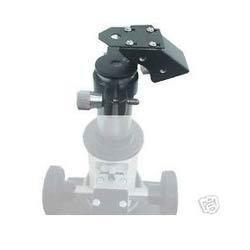
Tell us about your requirement

Price:
Quantity
Select Unit
- 50
- 100
- 200
- 250
- 500
- 1000+
Additional detail
Mobile number
Email

More Products in Microscopes Category
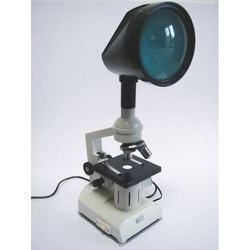
Projection Microscope
Coarse Adjustment Range : Range up to 20 mm.
View Head : Monocular, vertical projection.
Objective Achromatic : Achromatic objectives, 10x, 40x, 100x (oil immersion).
Drawtube : Other, Monocular, fixed vertical projection tube.
Image Format : Projected real image onto attached frosted glass screen.
Eyepiece Tube : Vertical, monocular projection tube.
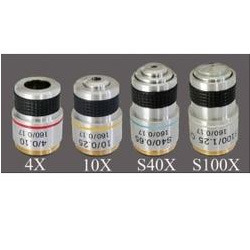
Objective Microscope
Coarse Adjustment Range : 20 mm
View Head : Monocular, inclined 45°
Objective Achromatic : 4/10/40/100X, DIN standard, achromatic glass lenses.
Drawtube : Other, Standard monocular drawtube compatible with most laboratory setups.
Image Format : None (no camera integration); visual observation only.
Eyepiece Tube : Monocular eyepiece tube, 23.2 mm diameter.
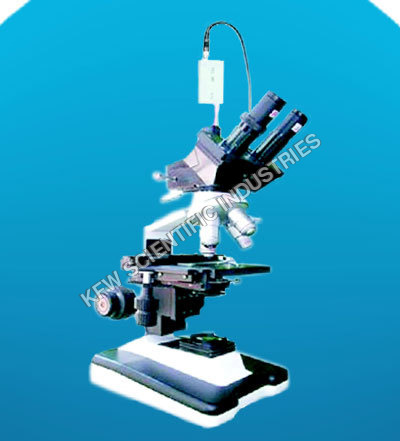
Trinocular Research Microscope
Coarse Adjustment Range : 15 mm
View Head : Trinocular, inclined at 45, rotatable 360
Objective Achromatic : Achromatic Objectives 4x, 10x, 40x (spring), 100x (oil, spring) standard
Drawtube : Trinocular
Image Format : Direct optical view; camera required for digital capture
Eyepiece Tube : Inclined at 45, 360 rotatable
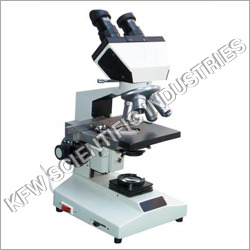
Binocular Microscopes
Coarse Adjustment Range : 15mm
View Head : Binocular, 360 Rotatable
Objective Achromatic : 4x, 10x, 40x (spring), 100x (oil, spring)
Drawtube : Other, Binocular, 360 Rotatable
Image Format : Visual Observation
Eyepiece Tube : Binocular, 45 inclined

 Send Inquiry


Our Products
- Slit Lamp Ophthalmic Equipment
- Slit Lamp
- Surgical Equipments
- Laboratories Instruments Equipment
- Microscopes
- Scientific Instruments
- ENT Equipment
- Pharmacy instrument equipment
- Pathological Equipment
- Physics Lab Equipments
- Physics instruments
- Laboratory Glassware
- Digital Polarimeter
- Microprocessor Viscometer
- Double Beam UV-VIS Spectrophotometer
- Single Beam UV-Vis Spectrophotometer
- Kitchen equipments
- Dental Equipment
- Chapati Making Machines
- Water Heating System OR Hamam
- High Performance Liquid Chromatography Systems
- Chemistry
- Equipment Accessories
- Gynecology Equipment


B.O : 5430/3, Anaj Mandi, Science Market, Near Nigar Cinema,
R.O : 102-B Ram Nagar,Ambala Cantt - 133001, Haryana, India

Mr VISHAL KUMAR
(Managing Director)
Mobile :07971671031
 Send Inquiry
Developed and Managed by Infocom Network Private Limited.
