
Call us now :07971671031
 Send Inquiry
 Send Inquiry
Dissecting Microscope (Bull Type)
Dissecting Microscope (Bull Type) Specification
- Features
- Sturdy cast iron base; anti-reflective paint finish; portable; easy maintenance.
- Spare Parts
- Supplied with extra pair of eyepieces and replacement stage plate.
- Focus System
- Rack and pinion coarse adjustment.
- View Head
- Monocular, vertical drawtube.
- Theory
- Bull Type Dissecting Microscope designed for low magnification observation of biological specimens.
- Drawtube
- Monocular vertical drawtube, rotatable.
- Sensor
- Not applicable (not digital).
- Resolution
- Depends on eyepiece and objective combination.
- Interface
- Mechanical, manual operation.
- Frame Rate
- Not applicable (not digital).
- Focal Distance
- Approx. 50 mm to 75 mm.
- Magnification
- 20x and 40x (provided by 10x and 20x eyepieces with 2x objective).
- Dimensions
- Approximate overall height 25 cm.
- Focus Range
- Coarse focus provided with rack and pinion mechanism.
- Eyepieces
- Paired 10x and 20x eyepieces included.
- Eyepiece Tube
- Single, vertical, rotatable.
- Illumination
- Plano-concave mirror for natural light; substage mirror arrangement.
- Coarse Adjustment Range
- Full range of rack and pinion focus.
- Fine Adjustment Range
- Not provided (only coarse focusing).
- Working Stage
- Square stage with two stage clips; glass plate and black/white plate included.
- Still Image Capture Resolution
- Not applicable (not digital).
- Video Capture Resolution
- Not applicable (not digital).
- Image Format
- Visual observation only (not applicable).
- Interpupillary Distance
- Fixed, not adjustable in monocular model.
- Objective Achromatic
- Supplied with 2x Achromatic Objective.
- Condenser
- Not applicable (not included).
- Light Source
- Plano-concave mirror; sunlight or laboratory lamp required.
- Accessories Supplied
- Two stage clips; glass and black/white stage plates; dust cover; manual.
- Rotatable Head
- 360-degree rotatable head for comfortable viewing.
- Base
- Heavy, stable, 'bull type' base for vibration-free working.
- Suitability
- Ideal for school and college laboratories for dissection and sample observation.
- Mirror Size
- Approximately 40 mm diameter.
- Construction Material
- Cast iron base, metal body.
- Finish
- Durable enamel paint.
- Stage Size
- Approximate dimensions 80 mm x 75 mm.
Dissecting Microscope (Bull Type) About
A special lens dia. 75mm to increase field of view. The bulls lens carrier is replaceable with normal eyepiece carrier complete with normal eyepieces 10x & 20x and a bulls lens carrier. Packed in Thermool Box.
Sturdy and Stable Design
Featuring a heavy bull type cast iron base, this dissecting microscope is engineered for stability during fine work. Its durable enamel finish guards against wear, ensuring a lasting presence in busy educational settings. The robust construction is complemented by anti-reflective paint, reducing glare and enhancing visual clarity during observations.
Optimized for Educational Use
Tailored for both schools and colleges, this microscope delivers essential features for dissecting and sample observation. The rotatable monocular head and ergonomic controls promote comfortable prolonged use. Included accessories such as stage clips, glass and black/white plates, dust cover, and spare eyepieces simplify setup and maintenance.
Easy and Versatile Operation
Manual operation is supported via a mechanical interface and rack and pinion coarse focusing system. The plano-concave mirror allows use under natural or lamp light, making the microscope flexible across multiple laboratory environments. Its simple, portable design enables quick relocation or classroom demonstrations.
FAQs of Dissecting Microscope (Bull Type):
Q: How is the Bull Type Dissecting Microscope used in laboratory dissection and sample observation?
A: This microscope is primarily intended for low magnification visual observation of biological specimens. Its large, stable stage and paired eyepieces make it easy to examine samples during dissections, providing clear, detailed views without digital features. It is ideal for teaching environments where hands-on sample study is essential.Q: What materials are used in the construction of this dissecting microscope?
A: The microscope features a sturdy cast iron base and a metal body finished with durable enamel paint. These materials were chosen for their strength, longevity, and resistance to laboratory wear, providing a stable foundation for precise observation.Q: When is it appropriate to use this microscope in an academic setting?
A: This microscope is best utilized during biology labs focused on dissecting tasks or studying larger specimens at low magnification levels. It allows students and educators to observe details not visible to the naked eye, especially during practical sessions in schools and colleges.Q: Where can the Bull Type Dissecting Microscope be installed or used?
A: Its durable and portable design means it is suitable for installation in school and college laboratories. The stable base ensures vibration-free working on standard lab tables, while its size allows for easy storage when not in use.Q: What is the process for focusing specimens on this microscope?
A: Focusing is accomplished using a rack and pinion coarse adjustment system directly connected to the monocular, rotatable drawtube. By manually rotating the knob, the user can bring specimens into clear view within a focal distance range of approximately 50 mm to 75 mm.Q: What are the benefits of the supplied accessories with this microscope?
A: The microscope comes with two stage clips, glass and black/white stage plates, a dust cover, extra eyepieces, and a manual. These accessories enhance convenience, protect the instrument, and allow users to adapt the stage surface to different specimen types for improved observation.Q: How does the illumination system work in the Bull Type Dissecting Microscope?
A: Illumination is provided by a plano-concave mirror situated below the stage. Users can direct natural sunlight or light from a laboratory lamp onto the sample, optimizing brightness as needed for clear observation without the need for electronic components.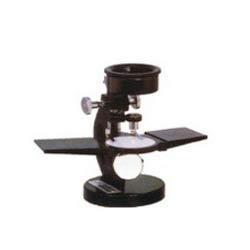
Tell us about your requirement

Price:
Quantity
Select Unit
- 50
- 100
- 200
- 250
- 500
- 1000+
Additional detail
Mobile number
Email

More Products in Microscope Category
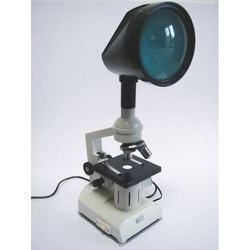
Projection Microscope
Objective Achromatic : Achromatic objectives, 10x, 40x, 100x (oil immersion).
Eyepiece Tube : Vertical, monocular projection tube.
Fine Adjustment Range : Precise movement, typically ±1.5 mm.
Coarse Adjustment Range : Range up to 20 mm.
Spare Parts : Projection bulbs, fuses, extra objectives, stage clips.
Light Source : Inbuilt tungsten lamp or LED illumination.
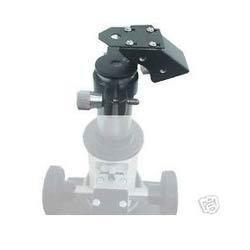
Camera Lucida Prism Type
Objective Achromatic : Compatible with achromatic and other standard objectives.
Eyepiece Tube : Accepts standard tube diameters (typically 23.2 mm/30 mm).
Fine Adjustment Range : Adjusted via microscopes fine focus control.
Coarse Adjustment Range : Adjusted via microscopes own focus mechanism.
Spare Parts : Replacement prism, mounting bracket, adjustment screws available.
Light Source : External/room light or microscope light source.
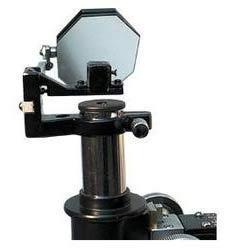
Camera Lucida (Mirror Type)
Objective Achromatic : Supports standard achromatic objectives.
Eyepiece Tube : Compatible with standard monocular and binocular tubes.
Fine Adjustment Range : Determined by attached microscope.
Coarse Adjustment Range : Determined by attached microscope.
Spare Parts : Mirror module, prism, mounting sleeve, screws.
Light Source : Ambient or external illumination.
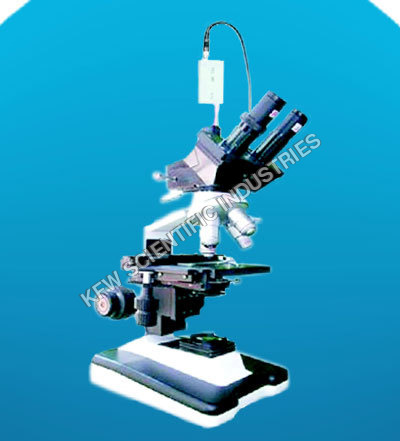
Trinocular Research Microscope
Objective Achromatic : Achromatic Objectives 4x, 10x, 40x (spring), 100x (oil, spring) standard
Eyepiece Tube : Inclined at 45, 360 rotatable
Fine Adjustment Range : 0.002 mm precision
Coarse Adjustment Range : 15 mm
Spare Parts : Power cord, fuse, dust cover, immersion oil, lamp, spare bulb
Light Source : Halogen Lamp 6V/20W or LED as per model

 Send Inquiry


Our Products
- Slit Lamp Ophthalmic Equipment
- Slit Lamp
- Surgical Equipments
- Laboratories Instruments Equipment
- Microscopes
- Scientific Instruments
- ENT Equipment
- Pharmacy instrument equipment
- Pathological Equipment
- Physics Lab Equipments
- Physics instruments
- Laboratory Glassware
- Digital Polarimeter
- Microprocessor Viscometer
- Double Beam UV-VIS Spectrophotometer
- Single Beam UV-Vis Spectrophotometer
- Kitchen equipments
- Dental Equipment
- Chapati Making Machines
- Water Heating System OR Hamam
- High Performance Liquid Chromatography Systems
- Chemistry
- Equipment Accessories
- Gynecology Equipment


B.O : 5430/3, Anaj Mandi, Science Market, Near Nigar Cinema,
R.O : 102-B Ram Nagar,Ambala Cantt - 133001, Haryana, India

Mr VISHAL KUMAR
(Managing Director)
Mobile :07971671031
 Send Inquiry
Developed and Managed by Infocom Network Private Limited.
