
Call us now :07971671031
 Send Inquiry
 Send Inquiry
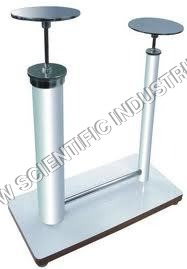
Electroscope
Electroscope Specification
- Measurement Range
- Detection of static electricity from low to moderate voltages
- Automation Grade
- Manual
- Power Source
- Not required; operates manually
- Core Components
- Insulating stand, metal rod, gold leaves, glass enclosure
- Feature
- Sensitive detection of static electric charge; visual indication via gold leaf divergence
- Accuracy
- Qualitative indication (not numerically graded)
- Model No
- Laboratory Standard Gold Leaf Electroscope
- Equipment Materials
- Metal body with glass window and gold leaves
- Type
- Gold Leaf Electroscope
- Dimension (L*W*H)
- Approx. 14 x 7 x 7 cm
- Base Type
- Stable rectangular metallic/plastic base
- Color
- Standard laboratory metallic finish, typically silver/grey
- Sensitivity
- Detects even weak static charges
- Visibility
- Clear viewing window on front
About Electroscope
This rugged, sensitive electroscope can accept various accessories to change its capacitance. A sensitive aluminium vane is balanced in a vertical position on a metal support which is insulated from its base. The vane is easily observed and projected on a chalkboard (Light Source, not included) on which an arbitrary scale has been marked. Height without attachments is about 9". Four attachment, each equipped with a banana plug which fits the vane system top, are included : a 1" conducting sphere; a 3" conducting sphere; a proof plane with detachable insulating handle; and an aluminium cup (Faraday ice pail). Attachments can be charged using either our Electrophorus or our Power Supply (not included). With instructions.
Sensitive and Reliable Static Charge Detection
This gold leaf electroscope efficiently identifies even weak static electric charges through visible movement of delicate gold leaves. Its manual operation and qualitative results make it a staple for laboratories and educational demonstrations. With glass enclosure and a well-designed insulated base, it ensures consistent performance and student safety during experiments.
Clear Viewing for Enhanced Demonstrations
The electroscope features a clear front glass window, allowing unobstructed observation of the gold leaves response to static electricity. This makes it perfect for group demonstrations and instructional use, highlighting the fundamental concepts of electrostatics in an intuitive, easily visible manner.
FAQs of Electroscope:
Q: How does the gold leaf electroscope detect static charges?
A: The electroscope detects static charges using the principle of repulsion between similarly charged gold leaves. When a charged object touches or comes close to the metal rod, static electricity transfers, causing the gold leaves inside the enclosure to separate from each other, making the presence of static charge visually apparent.Q: What materials are used in the construction of this electroscope?
A: The Laboratory Standard Gold Leaf Electroscope features a metallic or plastic base, a sturdy metal body, a clear glass window for observation, and highly sensitive gold leaves. An insulating stand provides additional safety and stability during measurements.Q: When should you use a gold leaf electroscope?
A: This device is ideal for experiments requiring the qualitative detection of static charges, such as physics demonstrations, laboratory coursework, and educational research in electrostatics. It is most commonly used in academic laboratories and classrooms.Q: Where is this electroscope typically utilized?
A: The gold leaf electroscope is widely used in laboratories, science classrooms, and research institutions for teaching and demonstrating the principles of static electricity and electrostatics.Q: What is the process for using the electroscope to detect charges?
A: To use the device, simply bring a charged object near or in contact with the metal rod at the top of the electroscope. Observe the gold leaves inside the glass enclosure; their divergence will indicate the presence and relative strength of a static charge.Q: What are the main benefits of this electroscope model?
A: This model offers sensitive, clear, and immediate detection of static electric charges. Its qualitative, visual output provides an effective learning experience, while the clear window and manual operation ensure ease of use and safety in various laboratory environments.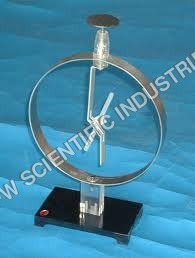
Tell us about your requirement

Price:
Quantity
Select Unit
- 50
- 100
- 200
- 250
- 500
- 1000+
Additional detail
Mobile number
Email

More Products in Physics instruments Category
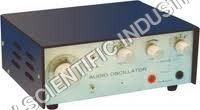
Audio Oscillator
Equipment Materials : Metal Body with Plastic Front Panel
Automation Grade : Manual
Dimension (L*W*H) : 225 mm x 180 mm x 90 mm
Power Source : AC Mains, 230V 50Hz
Core Components : Oscillator Circuit, Frequency Selector, Output Terminals
Type : Laboratory Audio Oscillator
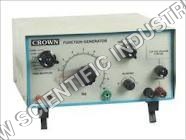
Function Generator
Equipment Materials : Metal, ABS plastic front panel
Automation Grade : Manual
Dimension (L*W*H) : 300 x 220 x 100 mm
Power Source : 220V AC, 50Hz
Core Components : Oscillator, Frequency Selector, Amplifier, Display Unit
Type : Function Generator
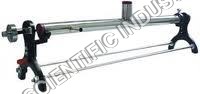
Linear Expansion Apparatus
Equipment Materials : Stainless steel tube, brass, aluminium
Automation Grade : Manual
Dimension (L*W*H) : 600 mm x 120 mm x 180 mm
Power Source : Electric heating element
Core Components : Test rod, heating tube, dial gauge, support stand
Type : Laboratory Instrument
Fluid Pressure Apparatus
Equipment Materials : Borosilicate Glass, Mild Steel, Brass Valves
Automation Grade : Manual
Dimension (L*W*H) : 450 mm x 300 mm x 600 mm
Power Source : Manual
Core Components : Manometer, Pressure Cylinder, Piping, Water Reservoir
Type : Fluid Pressure Apparatus

 Send Inquiry


Our Products
- Slit Lamp Ophthalmic Equipment
- Slit Lamp
- Surgical Equipments
- Laboratories Instruments Equipment
- Microscopes
- Scientific Instruments
- ENT Equipment
- Pharmacy instrument equipment
- Pathological Equipment
- Physics Lab Equipments
- Physics instruments
- Laboratory Glassware
- Digital Polarimeter
- Microprocessor Viscometer
- Double Beam UV-VIS Spectrophotometer
- Single Beam UV-Vis Spectrophotometer
- Kitchen equipments
- Dental Equipment
- Chapati Making Machines
- Water Heating System OR Hamam
- High Performance Liquid Chromatography Systems
- Chemistry
- Equipment Accessories
- Gynecology Equipment


B.O : 5430/3, Anaj Mandi, Science Market, Near Nigar Cinema,
R.O : 102-B Ram Nagar,Ambala Cantt - 133001, Haryana, India

Mr VISHAL KUMAR
(Managing Director)
Mobile :07971671031
 Send Inquiry
Developed and Managed by Infocom Network Private Limited.
